Santander - Cork
Ferry to Ireland
Santander - Cork
Ferry to Ireland
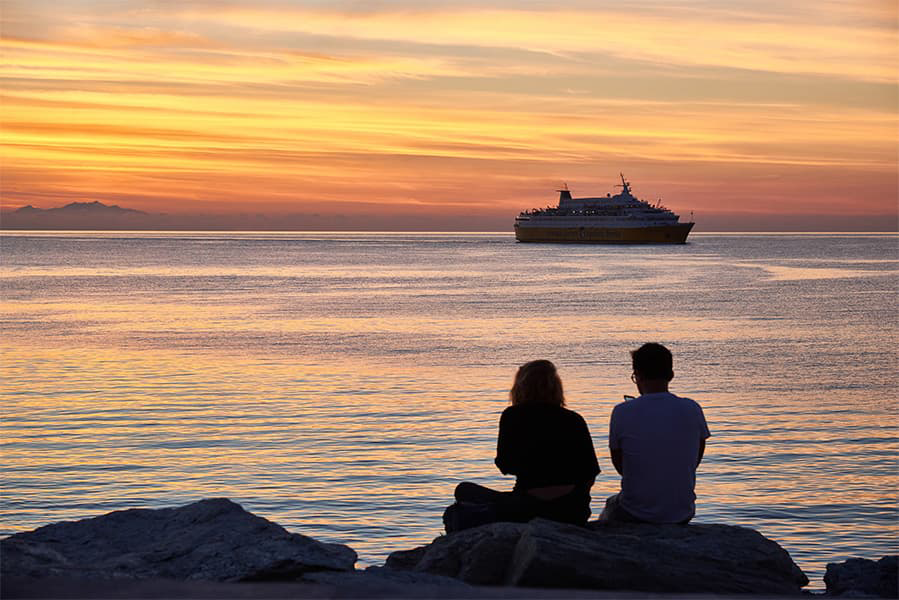
See ferry fares and operators from all over the world in one spot, and find the sailing that fits your trip. Booking early is usually the surest way to get a good price and plenty of choice.
Discounts are available with Direct Ferries all year round. If a senior discount applies to your crossing, it's applied for you automatically once the right age bracket is selected in the passenger options.
Students and recent graduates can claim a 5% saving. Register with our partner Student Beans to verify eligibility, then apply your discount code at checkout.
Resident discounts also apply to a number of Spanish and Italian routes — pick the "Residents" option during search and the fare adjusts automatically. Be ready to show proof of address, such as an ID card or residency certificate, at check-in.
Requirements for travel documents change from route to route, so check what's needed ahead of time. A valid passport is usually required for Santander to Cork travel, plus any visa or national ID relevant to your nationality. Since the rules depend on your citizenship and destination, our Check-in, Travel Documents & Tickets guide is the place to check for the latest guidance and avoid delays at check-in.
To book, just add your departure port, arrival port and preferred date, and you'll see every fare and sailing on offer. You can also compare alternative routes and times to find your best match.
Look out for early-bird pricing and flexible ticket options, such as upgrades or flexi-fares that let you make changes down the line. Entering accurate details — passenger count, vehicle specs and so on — keeps the process running smoothly.
As soon as your booking is confirmed, a confirmation email will land in your inbox. What happens next with your boarding pass depends on the operator you've booked.
Some operators issue boarding passes right away, while others need you to check in at the port itself. Where it's supported, the Direct Ferries app lets you check in online in advance.
You'll usually find ticket desks close to the ferry terminal. Giving yourself a little extra time before departure means you can collect tickets and check in without any stress.
Bring your confirmation email and valid photo ID, such as a passport or identity card, to check in. Pet owners should have vaccination and insurance documents on hand, and anyone with a resident discount should carry proof of address.
There are a few reasons departures from Santander to Cork might not show for your chosen date — a schedule change, sold-out sailings, or a seasonal lull are the most likely. Try another date or check alternative routes through our Route & Port finder.
Booking your Santander to Cork ferry well ahead of time generally works in your favour — you'll usually find better fares and a wider choice of departures and cabins.
A few weeks ahead is usually enough notice to catch the best offers, though fares can still fluctuate with the season and remaining space.
More routes than anyone else.

Compare fares, times & routes in one place.
Change plans easily with flexi tickets.

Book e-tickets & manage trips in-app.
Live ship tracking & real-time updates.

Top-rated customer support when you need it.
The Spanish city and port of Santander is the capital of the autonomous community and historical region of Cantabria on the north coast of Spain and lies to the east of Gijon and to the west of Bilbao. Popular tourist attractions in the city include the Cathedral of Santander, the lower temple (the "cripta del Cristo") was built in the 12th century on earlier Roman buildings. Its architectural style is a transition from Romanesque to Gothic. The upper church was built between the 13th and 14 the centuries.
Santander's port transports around 150,000 passengers each year to the ports of Plymouth and Portsmouth in the United Kingdom. The crossing time to Portsmouth is around 24 hours and 20 hours to Plymouth. The port has excellent road and rail facilities that provide good links with Portugal, the Spanish Costa's and other parts of Spain. Passenger facilities in the port include banks, supermarkets, a restaurant, tourist information desk and a souvenir shop.
The Irish city and port of Cork is located in the south west of Ireland and is the second largest city in Ireland and the third most populous city on the island of Ireland. It is located on the banks of the River Lee which divides into two channels as it approaches the western edge of the city. To the east of the city, where the two channels meet again and continue to flow on to Lough Mahon and Cork Harbour, are the city's quays. The city itself is located on the island that is created by the River Lee when it splits and then merges again.
Architecturally, Cork has a number of notable buildings that date back to medieval period through to the present day, although the only surviving medieval building is the Red Abbey. The city's two cathedrals are popular tourist attractions. St. Mary's Cathedral, sometimes called the North Cathedral, is the Catholic cathedral and work began on it in 1808 with its tower added in the 1860's. St. Fin Barre's Cathedral is the Protestant cathedral in the city and was built on the site of an earlier chapel. Work began on this cathedral in 1862 and was completed in 1879 under the direction of the architect William Burges.