Oslo - Copenhagen
Ferry to Denmark
Oslo - Copenhagen
Ferry to Denmark
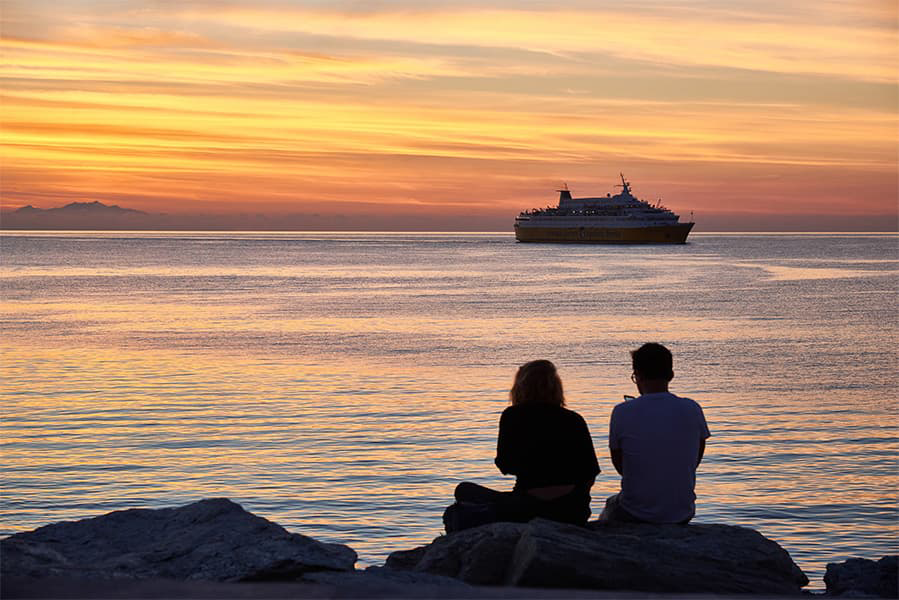
See ferry fares and operators from all over the world in one spot, and find the sailing that fits your trip. Booking early is usually the surest way to get a good price and plenty of choice.
Discounts are available with Direct Ferries all year round. If a senior discount applies to your crossing, it's applied for you automatically once the right age bracket is selected in the passenger options.
Students and recent graduates can claim a 5% saving. Register with our partner Student Beans to verify eligibility, then apply your discount code at checkout.
Resident discounts also apply to a number of Spanish and Italian routes — pick the "Residents" option during search and the fare adjusts automatically. Be ready to show proof of address, such as an ID card or residency certificate, at check-in.
Requirements for travel documents change from route to route, so check what's needed ahead of time. A valid passport is usually required for Oslo to Copenhagen travel, plus any visa or national ID relevant to your nationality. Since the rules depend on your citizenship and destination, our Check-in, Travel Documents & Tickets guide is the place to check for the latest guidance and avoid delays at check-in.
To book, just add your departure port, arrival port and preferred date, and you'll see every fare and sailing on offer. You can also compare alternative routes and times to find your best match.
Look out for early-bird pricing and flexible ticket options, such as upgrades or flexi-fares that let you make changes down the line. Entering accurate details — passenger count, vehicle specs and so on — keeps the process running smoothly.
As soon as your booking is confirmed, a confirmation email will land in your inbox. What happens next with your boarding pass depends on the operator you've booked.
Some operators issue boarding passes right away, while others need you to check in at the port itself. Where it's supported, the Direct Ferries app lets you check in online in advance.
You'll usually find ticket desks close to the ferry terminal. Giving yourself a little extra time before departure means you can collect tickets and check in without any stress.
Bring your confirmation email and valid photo ID, such as a passport or identity card, to check in. Pet owners should have vaccination and insurance documents on hand, and anyone with a resident discount should carry proof of address.
There are a few reasons departures from Oslo to Copenhagen might not show for your chosen date — a schedule change, sold-out sailings, or a seasonal lull are the most likely. Try another date or check alternative routes through our Route & Port finder.
Booking your Oslo to Copenhagen ferry well ahead of time generally works in your favour — you'll usually find better fares and a wider choice of departures and cabins.
A few weeks ahead is usually enough notice to catch the best offers, though fares can still fluctuate with the season and remaining space.
More routes than anyone else.

Compare fares, times & routes in one place.
Change plans easily with flexi tickets.

Book e-tickets & manage trips in-app.
Live ship tracking & real-time updates.

Top-rated customer support when you need it.
The capital of Norway is the city of Oslo and is located on an arc of land at the northernmost end of Oslofjord which is almost divided by the Nesodden Peninsular, opposite the city. The city is bounded on its other sides by hills and mountains and is comprised of around 40 islands within its city boundary. It is relatively easy to get around this compact city using public transport or alternatively bicycles can be rented across the city. There are many things to see and do in Oslo including seeing the works by the celebrated artist Edvard Munch. His works can be found in a number of institutions in the city along with other Norwegian and international artists. The Norwegian government has recently invested large amounts of money in cultural installations, facilities, buildings and festivals in the City of Oslo.
From the city's port, ferries can be taken to destinations in Denmark and Germany. There are daily crossings to Copenhagen with a crossing time of around 16 hours, to Hirtshals with a crossing time of around 10 hours to Frederikshavn with a crossing time of 8 hours and 30 minutes and to Kiel in Germany with a crossing time of around 20 hours. Passenger facilities in Oslo's ferry terminal are rather limited although there is a coffee shop and a small departure hall.
The city of Copenhagen is located on the east coast of Zealand and is Denmark's capital city. It lies around 40 km to the north west of Malmo in Sweden and around 165 km to the north east of Odense. The city's boundaries extend to parts of the island of Amager and also includes a part of Frederiksberg. The city has received quite a bit of investment in its institutions and infrastructure over the past 10 years or so which in turn has resulted in significant urban and cultural development. Copenhagen is one of northern Europe's major financial centres, home to the Copenhagen Stock Exchange, and is Denmark's cultural, economic and governmental hub.
The city was recognised as the third richest city in the world, by gross earnings, in 2012 which is actually a fall as it was ranked number 1 in 2009. The completion of the Oresund Bridge, which carries rail and roads, Copenhagen has become ever more integrated with the Swedish province of Scania, and its largest city, Malmo.
Ferry services from the city's port depart to destinations in Sweden, Norway and Poland.